
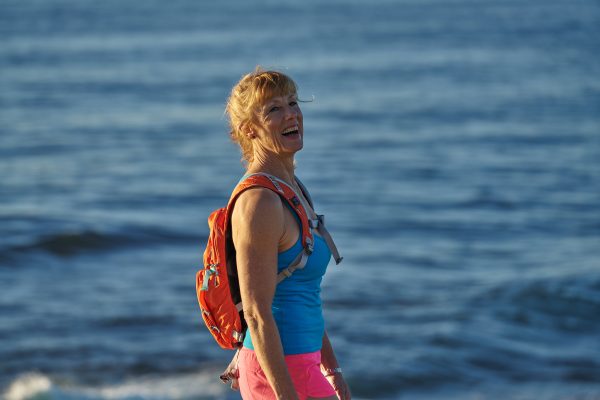

By Di Westaway OAM – Chief Adventure Chick, Health Activist & Lifestyle Medicine Practitioner
I clearly remember the moment. My friend swans into my birthday lunch wearing the body of an 18-year-old, glowing, lean, and seemingly ageing backwards. I tell her she looks fabulous—but inside, my mind is reeling.
It’s not just her impossibly svelte figure. She seems more vibrant and confident, in a gaunt sunken kind of way.
Later, between the sourdough and the spritz, she casually mentions she’s been microdosing Ozempic. Like it’s a multivitamin.
The best part, she says, isn’t even the weight loss.
“It’s the brain space. No food noise,” she says.
Oh.
She also mentions the nausea and constipation eventually pass. A small price to pay, apparently, for looking like you’ve outlasted Gina Chick on Alone.
She picks at her pizza like a sparrow and stops after one glass of bubbles. Pleasure girl gone.
It all makes me wonder if I could ever be tempted to join the growing tribe of women discreetly injecting themselves—not because they’re obese, or even overweight. But because they’re exhausted from decades of body battles, food noise, shame, and the relentless pressure to shrink.
Maybe they think that being thinner will heal something inside them that’s been tender for as long as they can remember. Maybe they want to reclaim their youth. Or maybe, like me, they want to restore their inner athlete so they can keep climbing mountains into their eighties.
I see the appeal, and so does everyone else, which is why weight loss peptides are suddenly everywhere.
Celebrities discovered them during Covid. While the rest of us found five kilos in lockdown, the Hollywood set lost them. New bodies floated along red carpets, with hollow collarbones and matchstick arms we hadn’t seen since the 90s. The media wondered if ‘Ozempic chic is the new heroin chic’, while doctors embraced the various new strains of GLP-1 peptides, calling for limited supplies to be reserved for those with diabetes, not those who wanted to drop ‘the last five kilos’.
These days, they’re big business, and everybody wants a piece of the action. As the research continues, the pharmaceutical, supplement and longevity industries are promoting and patenting them for profit.
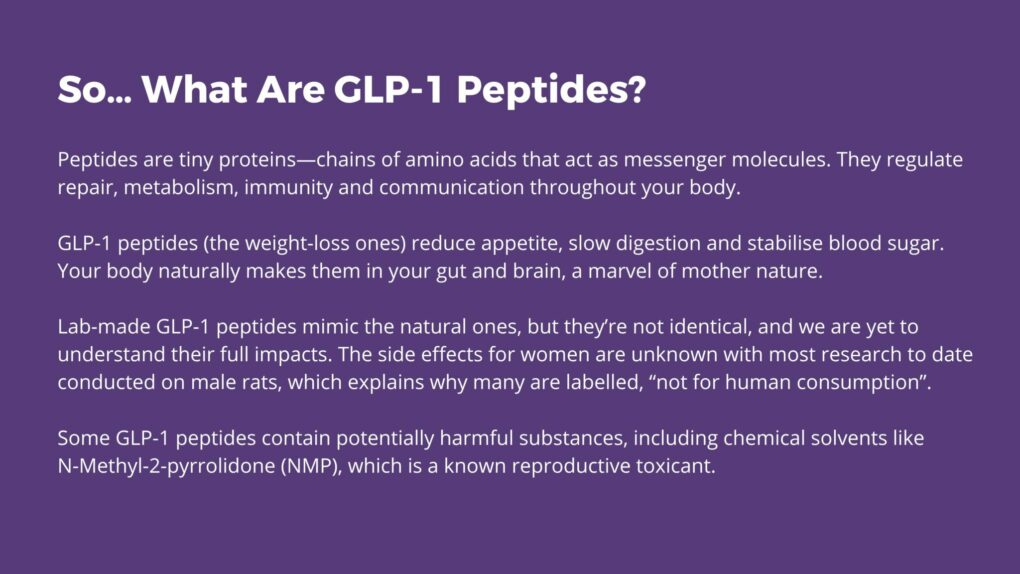
As someone who works in the women’s health space, I’ve been wrestling with this issue ever since I first heard of these miracle molecules. This is huge. But is it good for us? Is it the beginning of a new era of drugs that can cure disease? Or is it just another confusing, expensive rebrand of “health” that keeps us shrinking to fit a system built on our insecurity?
My take? If we’re voluntarily injecting ourselves just to be skinny, it’s worse than Brave New World. It’s not empowerment. It is a seductive dystopia of compliance which threatens to erode our autonomy, our health, and our well‑being.
The promise of easy thinness through a manmade synthetic molecule masks deeper risks: body image pressure, complex side effects, and a culture increasingly addicted to looksmaxxing.
Whilst microdosing GLP-1’s is not yet approved by the TGA, it soon will be, despite the risks. And those risks aren’t just limited to a bit of an upset stomach. In March 2026, the U.S. FDA cautioned pharmaceutical companies for failing to report adverse GLP1 reactions, including three deaths and up to 1,800 severe cases of intestinal blockages, vision loss, suicidal ideation, pancreatitis and gallbladder disease.
Class actions will follow. Investigations will multiply. But despite this, the market booms.
Reclaiming Your Power
The biggest problem with GLP‑1 drugs is that they suppress appetite without regard for nourishment, which can lead to gut imbalance, muscle loss, bone degeneration, dependency and metabolic dysfunction, and worst of all, dependency.
They’ll help you lose weight, but you’ll also lose muscle, strength, endurance, resilience, vitality, and confidence in your body. These drugs risk creating a generation of women who can’t lift, climb, run or play. They could also cost us our ability to bear children and nourish them.
This is the opposite of healthy living. GLP‑1 drugs are an unsustainable, pleasure‑numbing shortcut. Imagine swapping your morning coffee ritual for a syringe. No thanks. A drug will never be a substitute for nutrition, exercise, nature, sleep, connection and mindfulness.
So how do we navigate this brave new peptide-fuelled world—stoked by influencers, filtered bodies and decades of body battles?
We must relearn how to nurture our bodies and give them what they need to flourish.
While the race for the next patentable drug heats up, it’s more important than ever to remember: your body is not a problem to be fixed. She’s a miracle that needs nourishment, movement, nature, sleep, connection and joy—not a weekly jab.
And here’s the wild woman truth: the most natural way to get fitter, stronger, leaner and more confident, is a long-distance hike. Science now backs what our cave‑woman ancestors already knew—hiking is ancient medicine.
Research shows that regular hiking triggers autophagy (cell repair), reduces inflammation, boosts immunity, improves brain function, balances hormones, supports detoxification, improves mental health and repairs your microbiome. It also boosts GLP‑1 production naturally.
A 2026 review confirmed what we’ve always known: outdoor hiking improves cardiovascular health, mood, immunity, stress resilience and overall vitality.
You don’t need an injection to make more GLP‑1. You need nature’s food, movement, rest and connection.
Your body will make her own peptides to regulate hunger—if you feed her protein, fibre, healthy fats, fermented foods, and no processed junk. If you move her daily. If you let her sleep. If you let her breathe.
Hiking builds muscle, strengthens your heart, improves balance, nurtures your circadian rhythm, lowers stress and lifts your mood. Is it easy? Hell no. Is it worth it? Hell yes.
Because here’s the truth:
You are not broken.
You are not failing.
You are not a problem to be fixed with a needle.
You are the miracle. Not the peptide.
When you learn how your body actually works—your hormones, your metabolism, your cycles—you’ll stop fighting yourself. And you’ll start to fall in love with the body, mind and spirit, you’re living in.